


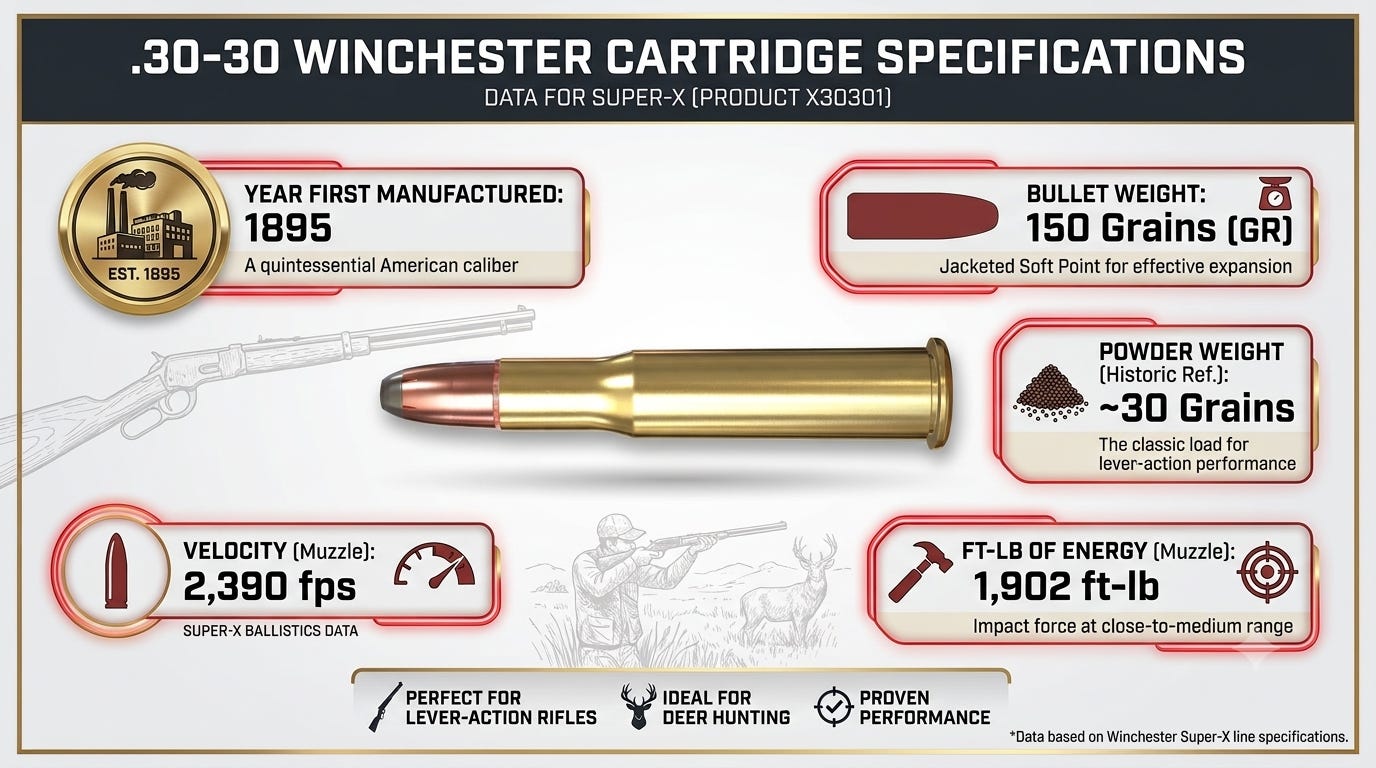
Since roughly the Carter administration, the firearms industry has been trying to murder the .30-30 Winchester.
Every decade, a new marketing savior arrives, heralded by a chorus of gun writers declaring that the old, blunt-nosed cartridge from 1895 is finally, officially dead. In 1975, they said the .308 would make it obsolete. In 1985, it was the 7mm-08. In 1995, we entered the great Magnum craze, where we slapped the word ‘Magnum’ on everything short of a starter pistol to sell more rifles. By 2005, the short magnums were going to bury it. Ten years later, the 6.5 Creedmoor was the designated killer. And today, we’re told the .350 Legend is the final nail in the coffin.
Meanwhile, out in the real world, the humble .30-30 lever gun quietly continues to kill white-tailed deer by the trainload every single autumn.
My affable co-host, Roy Huntington, likes to call the .30-30 the ‘adjustable wrench’ of the gun world. It’s a perfect analogy. You don’t pull an adjustable wrench out of your toolbox to show off your sophisticated mechanical taste. You don’t admire its aerodynamic lines. You use it because it’s the tool that handles 99 percent of the jobs you actually need to do on any given Tuesday.
Yet, the ballistic snobs look down their noses at it. They compare a $1,500 precision bolt-action rifle shooting from a sandbag rest at a laser-ranged target to a century-old lever-action rifle shot over the hood of a dusty pickup truck. ‘Look,’ they sneer, ‘your lever-action only shoots a four-inch group at a hundred yards.’
To which I say: so what?
First of all, that accuracy myth is mostly dead anyway. I recently tested one of the new Marlin 336s built on Ruger’s brand-new machinery. Paired with modern polymer-tipped ammo like Hornady’s LEVERevolution, that lever gun was consistently punching sub-one-inch, sub-MOA groups at a hundred yards. The gun is accurate enough. The cartridge is accurate enough.
But more importantly, let’s talk about how hunting actually happens.
I was on a hunt in Oklahoma a while back with a Benelli Lupo—a magnificent, incredibly accurate European bolt-action rifle. The guides set me up in a blind where the closest realistic shot was a laser-verified 452 yards away. I saw deer, but I didn’t feel comfortable taking a shot at that distance with an unfamiliar rifle. I didn’t want to be the guy who wounds an animal just to prove a point.
So, on the final afternoon, with a massive weather front rolling in, I ignored the guides. I hiked around the perimeter of the field, figured out where the deer were actually moving, and set up in the brush. I took a beautiful buck at exactly 35 yards. One shot, one clean kill.
When I wrote the review of that high-tech bolt rifle, I had to admit it was the most under-tested cover gun in history. Because the truth is, a 130-year-old Model 94 Winchester lever gun in .30-30 would have done the exact same job, just as cleanly. Nothing against the Lupo, but it was a sports car when all I needed was a pickup truck.
Most deer hunting in America—especially east of the Mississippi—happens at double-digit yardage. If you can get within a hundred yards of a deer, you don’t need a hyper-velocity cartridge designed to cross mountain valleys in Wyoming. You need a fast-handling, lightweight rifle that points naturally and puts a chunk of lead exactly where it belongs.
We’ve all met the guy who lives on a farm in Pennsylvania or Indiana. He carries an old Model 94 he bought in 1961. He has a box of ammo in his drawer that he bought twenty years ago. There are nineteen empty spaces in that box because he’s shot nineteen deer with nineteen single shots. If you ask him why he doesn’t upgrade to a modern short magnum, he’ll look at you like you’ve lost your mind.
He doesn’t need a marketing department to tell him what works.
So, let the ballistic purists scoff. Let them chase the latest, flattest-shooting, barrel-burning cartridge of the month. There’s nothing wrong with new technology, and we certainly don’t begrudge anyone their shiny new toys. But don’t let the marketing machine shame you into thinking your grandfather’s rifle is obsolete.
The .30-30 might be the Rodney Dangerfield of cartridges—it don’t get no respect from the internet experts. But in the deep woods where the leaves are damp and the deer are close, it’s still the king.
A most excellent article. I have a variety of battlefield, and specialty rifles, yet still have my trusty model 94. It shoots totally flat, and never falters. I call it the politically correct assault rifle. It doesn't have a bunch of do-dads sticking out of it to hang up in the brush, has a powerful enough load for even a black bear, and you can continuously “top off” the magazine without any breakdown. They can call it dead all they want, but America’s deer rifle hasn't gone anywhere.
always wanted one but ammo cost was to high. Now the cost of a decent lever action is insanely high.
My compromise was 7.62×39, both semi auto and bolt action. When I stocked up I paid .20 cents a round. Even now it is 55 to 60 cents a round compared to 90c to well over a dollar a round for 30-30. Ballistically they are very close.
30-30 has the advantage in kinetic energy in that it typically starts at 150 grains and goes to 180 or 200 grains for the bullets with it reaching 2000 ftlbs at muzzel with right bullet while the 7.62×38 is around 1500 ftlbs. 7.62 is 123 grains to 150 grains. both are 30 caliber rounds and will stop a deer or boar in it’s tracks.
I run 123 grain soft points in general and 150 grain softpoints for hunting. Honestly though 123 grain does well for hunting also.