


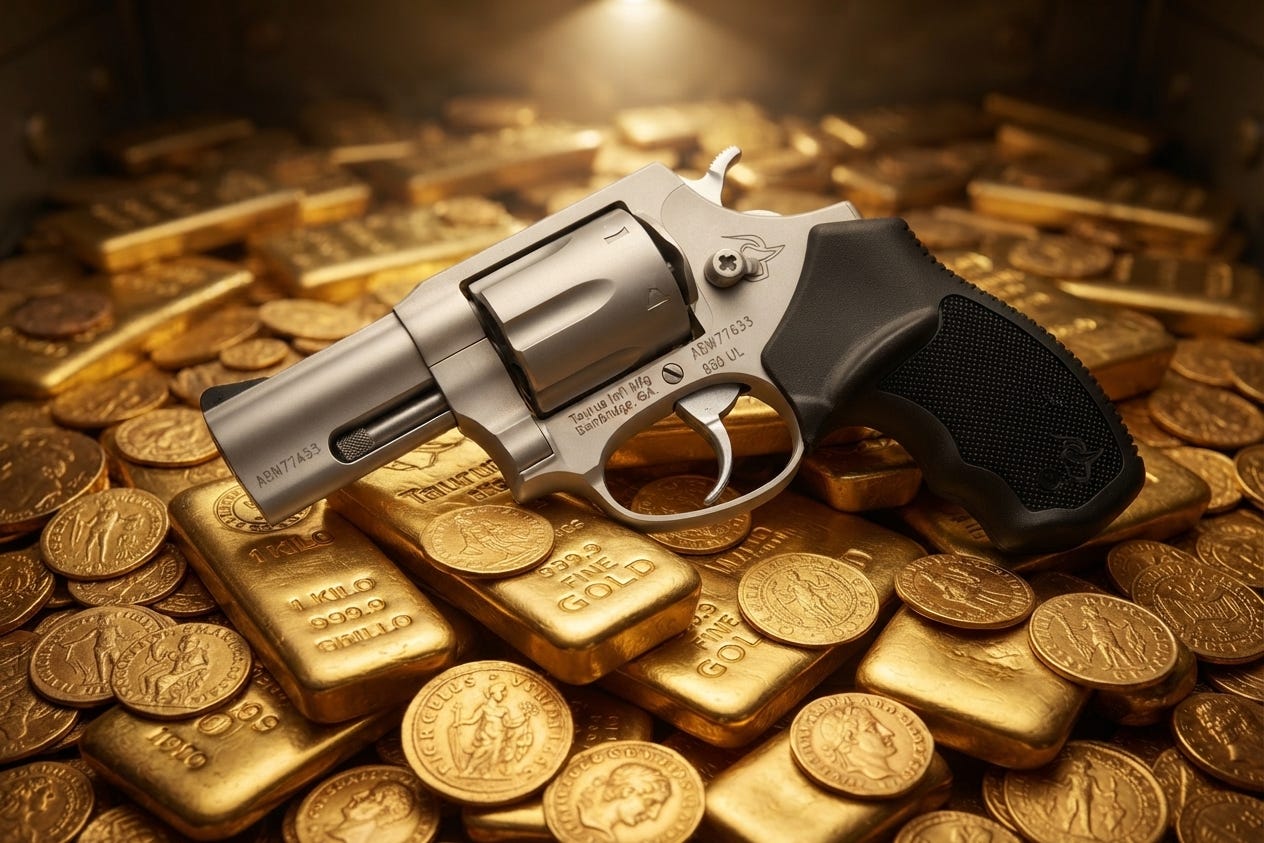
People love to look down their noses at cheap pocket pistols. Walk into any modern indoor shooting range with a Charter Arms or a Taurus, and you will likely receive a few condescending smirks from the guys sporting higher-cost CCW pistols. Unfortunately, gun culture has developed a weird, elitist obsession with price tags. Somehow, spending a month’s mortgage payment on a five-shot revolver has become the baseline for “class.”
Roy Huntington and I recently sat down to dissect this phenomenon in the latest episode of Guns Podcast US - Stop Shaming ‘Budget’ Snubbies! #344 . He brought up a brilliant point that completely reframes the entire argument: we need to stop calling these affordable options “budget” or “cheap” guns. Calling something “budget” implies a compromise in safety or reliability. These are actually standard-price revolvers; utra-premium custom guns are the outliers. Regular unleaded gasoline gets you to the grocery store just as reliably as premium fuel. Your defensive firearm functions under the exact same principle.
Manufacturing technology has fundamentally changed the landscape of firearms production. Modern CNC machining allows makers like Taurus or Rock Island to churn out frames with microscopic consistency. Tolerances are tighter than they have ever been. The massive quality gap that existed thirty years ago has virtually evaporated. Ironically, some premium manufacturers have actually struggled with quality control lately because they try to eliminate human intervention entirely to maximize profit margins. You are often paying for a name brand and a high-polish finish rather than superior mechanical reliability.
Admittedly, a four-hundred-dollar revolver can feel a bit gritty straight out of the box. The internal parts might not have received the hand-polishing of a high-end Smith & Wesson but resolving this issue does not require an expensive trip to a gunsmith. You just need to dry fire the snot out of it!
Clear the revolver, verify it is completely empty, squirt some light oil into the action, and pull the trigger five hundred times while watching television. This simple process seats the internal components and smooths out the rough edges naturally. Also, do not immediately install a lighter aftermarket spring kit on a brand-new gun. Light springs on a rough, unbroken-in action will only cause ignition failures. Break the gun in first, then decide if you actually need to swap parts.
There is also a massive psychological benefit to carrying an inexpensive firearm. High-end custom guns make people timid. You worry about scratches, holster wear, sweat, and pocket lint. You end up babying a tool that is supposed to save your life. A well-worn Charter Arms Bulldog or a polymer-framed Taurus Judge can ride in a dusty tractor holster or a sweaty front pocket without causing a single moment of lost sleep. Guns, at least the CCW version, are supposed to be tools, not museum pieces.
Roy carried a Charter Arms Bulldog .44 Special in an ankle holster during his police days. A highly respected, world-famous shooting instructor we knew chose that exact same gun as his primary defensive piece. These guys could have carried literally any firearm on the planet. They chose standard-price, utilitarian tools because they worked.
Worry less about the logo stamped on the frame. Focus instead on whether the cylinder rotates, the firing pin strikes- and most importantly- you can hit your target when the adrenaline dumps. Having a reliable gun in your pocket beats leaving a thousand-dollar safe queen at home every single time
.
The Millennials that run most Gun Stores now are the biggest bunch of WOMEN I've ever met. A Taurus is a good gun. They don’t know what the fuck they’re talking about.
Very good advice! Invest your retirement savings account in a carry gun? First, what's the most important attribute? Reliability, its gotta make noise when its loaded and the trigger pulled. Second? Durability, it ought to work for a long time without breaking. Oh, and if you do use it for its intended purpose, it WILL wind up in a police evidence locker, not in your gun safe. Not a place for my Colts, Kimbers, and Smith & Wessons (unless SHTF).
My attitude changed when, as I studied all aspects of Self-Defence; reading Chris Bird's book; The Concealed Handgun Manual. Many folks were alive; using handguns that the newsstand glossy writers decided were unfit to touch, much less shoot. Jennings, Bryco, Sundance, RG, etc.
So, I began to carry a Kel-Tec P32. Most newsstand glossy writers only grudgingly admitted to shooting one, some confessed to having one buried in the dust at the bottom of the gun safe. Oddly enough those were ex-undercover police officers. One would think if they needed a gun, it must work without f When I determined an upgrade was necessary, it is a Kel-Tec PF-9. Both ain't pretty; the only failure of either to go bang is when one of my practice handloads failed.
Now, since I've been without a short barreled, small frame snubby for about 27 years; I decided to rectify that. I recently acquired a Ruger LCR in 38 Spl +P. From previous experience with a much abused Colt Cobra, standard pressure 38's are manly enough; +P loads will be beastly. As in possible orthopaedically damaging. The LCR may look as ugly as mortal sin; but is very ergonomic and has a trigger thar rivals my 50 year old and much shot M-17. Did I mention it was $200 less than the J-frame 38 next to it in the Dealer's counter. $200 buys at least a pound of powder and 1000 Small Pistol Primers and 500 cast lead bullets. By fall, it may be in carry rotation.