


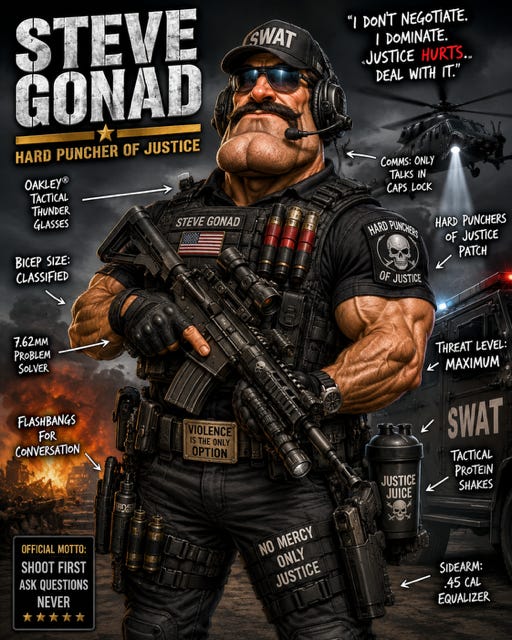
We’ve all seen him. If you’ve spent more than five minutes online or walked past the racks of AR's at a local gun show, you’ve run into “Sergeant Gonad.” He’s the guy with the custom-tailored uniform sleeves designed to squeeze his biceps into a permanent state of vascular display. His bicep size is classified, his posture is perpetually aggressive, and his YouTube channel is a masterclass in high-speed, low-drag fantasy gear.
He wants to sell you a tactical protein shake, a compensator that looks like a billet aluminum hood ornament and a red dot optic with more reticle options than a fifth generation fighter jet. And for a long time, the firearms industry has been more than happy to let the hyper-tactical crowd set the agenda.
But real life has a funny way of popping tactical balloons.
In this week’s episode of the Guns Podcast US, Roy Huntington and I discussed a letter from a listener named David, a retired 30-year law enforcement veteran. David actually had to pull the trigger in the line of duty. He was facing a barricaded suspect in an apartment doorway armed with a long gun, resulting in a tense, twenty-minute standoff.
When the suspect finally leveled the weapon, David fired. And at 16 yards, his first shot missed the suspect’s head by two and a half inches, chewing into the doorframe. Why? Because despite decades of training and range officers screaming “front sight focus,” David’s eyes didn’t track his front sight in that split second. His focus was locked in a biological vise-grip on the only thing that mattered in that millisecond: the threat.
David’s second shot connected after he forced his focus back to the sights, but his story highlights a massive, ongoing debate in the gun community: Red Dots vs. Iron Sights.
Disagreements
If you ask my illustrious co-host Roy, he will tell you he’s a staunch iron-sight guy. His philosophy makes a ton of sense: in a high-stress, close-range “get off me” situation, your brain’s primal response is to stare directly at the threat. To Roy, adding a miniature television screen to your slide just introduces a battery-operated variable you don’t need when pure gun-handling skills and threat-indexing are what save your life.
I look at it a bit differently. For me, a quality red dot (or green dot, my personal preference) is an incredible tool. It allows me to keep my target in sharp focus without fighting the blurry front-sight alignment that comes with age. If a piece of technology makes you faster, cleaner, and more confident on the glass, there is absolutely a place for it.
The truth is, both systems work. The key isn’t which piece of glass you bolt to your slide; it’s being entirely competent with whatever you choose to carry.
This same logic applies to the caliber of our carry guns. We are constantly told we need 10mm pocket rockets or .357 SIG hand-cannons because standard 9mm just doesn’t have the “stopping power.” But unless your name is Rob Leatham, full-house defensive loads in those heavy calibers usually just turn a controllable tool into a wrist-snapping flinch-generator. Power is a secondary variable; putting the bullet where it belongs is the only thing that punches your ticket home.
Takeaway
Whether you prefer the simplicity of classic iron sights like Roy, or the visual clarity of a modern red dot like me, technology will never replace basic, boring, repetitive gun-handling skills. David, who is now in a wheelchair, rightly noted that his primary concern these days is simply clearing his clothing and getting the gun out smoothly. If you fumble your draw, it doesn’t matter what kind of sights are on the gun.
So, next time you see Commander Gonad flexing his classified biceps on your screen, don’t rush out to buy more gear. Take your favorite carry gun—whatever sight configuration is on it—and go practice dry-firing (safely) in the living room. You don’t need more gadgets. You just need to be lethal with what you already have.
What’s your take on the great optics debate? Are you Team Iron Sights like Roy, or do you prefer a red dot? Let me know in the comments.
It's quite satisfying to see from the comments that shooters still recognize the three best ways to become proficient: "Practice, practice, practice!"
There Is no replacement for practice, practice, practice.