


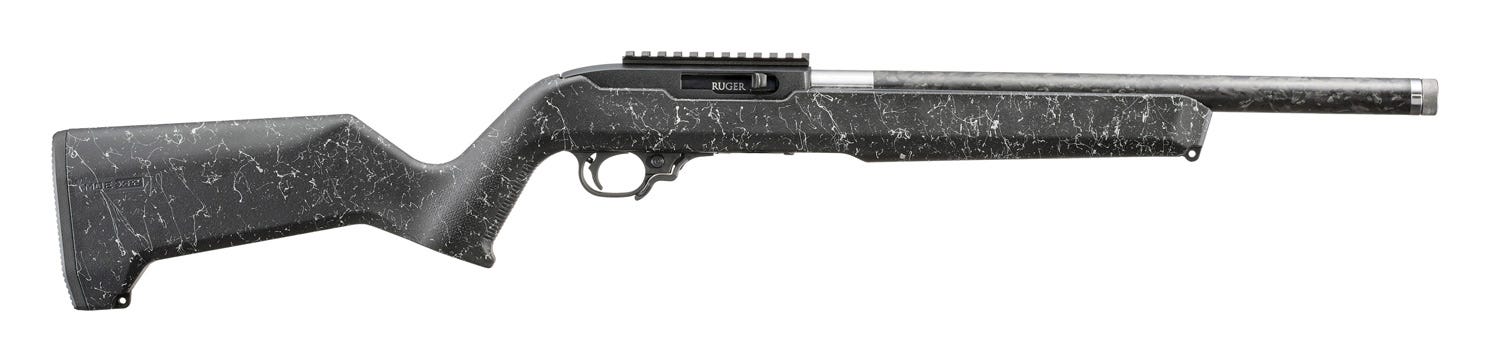
If you’ve been around the shooting world long enough, you probably internalized a universal “truth”: if you want real accuracy out of a .22 LR, you buy a bolt-action. For decades, semi-autos like the classic 10/22 or the Marlin Model 60 were fun, affordable, and incredibly reliable, but they were fundamentally “minute-of-barn-door” rifles. In GunsPodcast.US Episode #330, my co-host Roy Huntington admits he was one of those guys—until a brand new factory rifle completely shattered his preconceived notions and proved that the old rules no longer apply. Roy has spent decades chasing precision, dropping thousands of dollars on custom barrels, match triggers, and aftermarket stocks just to squeeze bolt-gun accuracy out of a semi-automatic platform. But in this episode, we dive into his hands-on experience with the new Ruger 10/22 Carbon Fiber.
Weighing in at a feathery four pounds and sporting a $650 MSRP, this out-of-the-box rifle didn’t just meet his expectations; it delivered ragged one-hole groups at 50 yards, equaling many of his custom builds. More than just a review of a neat new gun, Episode #330 is a fascinating look at the “Golden Age” of firearms manufacturing.
We discuss how modern CNC and EDM machining have completely revolutionized the industry, replacing the charming but inconsistent file-and-fit methods of the past with unparalleled, reproducible precision. Grab a cup of coffee and settle in—this is a masterclass on why today’s factory guns are the best we’ve ever seen.
Key Takeaways
The Semi-Auto Myth is Dead: The new Ruger 10/22 Carbon Fiber delivers out-of-the-box precision that rivals, and often beats, high-end vintage bolt-action rifles.
Custom Precision at a Factory Price: Building a comparable custom 10/22 used to cost between $1,500 and $2,000; today, modern factory rifles offer the same turnkey performance for a fraction of the cost.
The Golden Age of Manufacturing: The shift from conventional machining to advanced CNC technology means perfect, identical parts every single time, drastically improving quality control and lowering costs for the end consumer.
Listen on Libsyn: https://directory.libsyn.com/episode/index/id/40796340