


There’s a certain kind of insult that doesn’t land the way people think it does.
Call someone a “Fudd” in the gun world and the assumption is you’ve just dismissed them—written them off as outdated, out of touch, clinging to the past. The funny part is, the older I get, the less that bothers me. In fact, I’ve started to see it as a kind of accidental compliment.
Because buried underneath the label is usually something else: experience. Not theoretical experience, not “I watched a video” experience but the kind that comes from doing something long enough to see the cycles repeat and the fads come and go.
This week on the podcast, we leaned into that tension a bit. The idea was simple: what if you shot like it was 1955?
Not as nostalgia or rejection of modern techniques but as a corrective.
There’s a version of the modern shooting culture that is all gas pedal. Faster draws. Faster splits. Faster everything. It looks good, it feels good, and—if we’re being honest—it’s a lot more fun to practice than the alternative.
The alternative is slow.
Deliberate.
Quietly frustrating.
Bullseye shooting is not exciting content. It doesn’t make for great YouTube clips. There’s no soundtrack behind it, no timer beeping in your ear, no sense that you’re preparing for some cinematic moment. It’s just you, the gun, and the uncomfortable realization your fundamentals are not as solid as you thought they were.
That is the part people tend to avoid.
I get it. Nobody wants to stand there and watch their own limitations play out in real time. It’s much easier to move faster and call it progress. Speed can hide a lot. It can “cover” for a sloppy trigger press, a limp wrist, a bad sight picture. You can convince yourself you’re getting better because you’re doing more, but accuracy has a way of telling the truth.
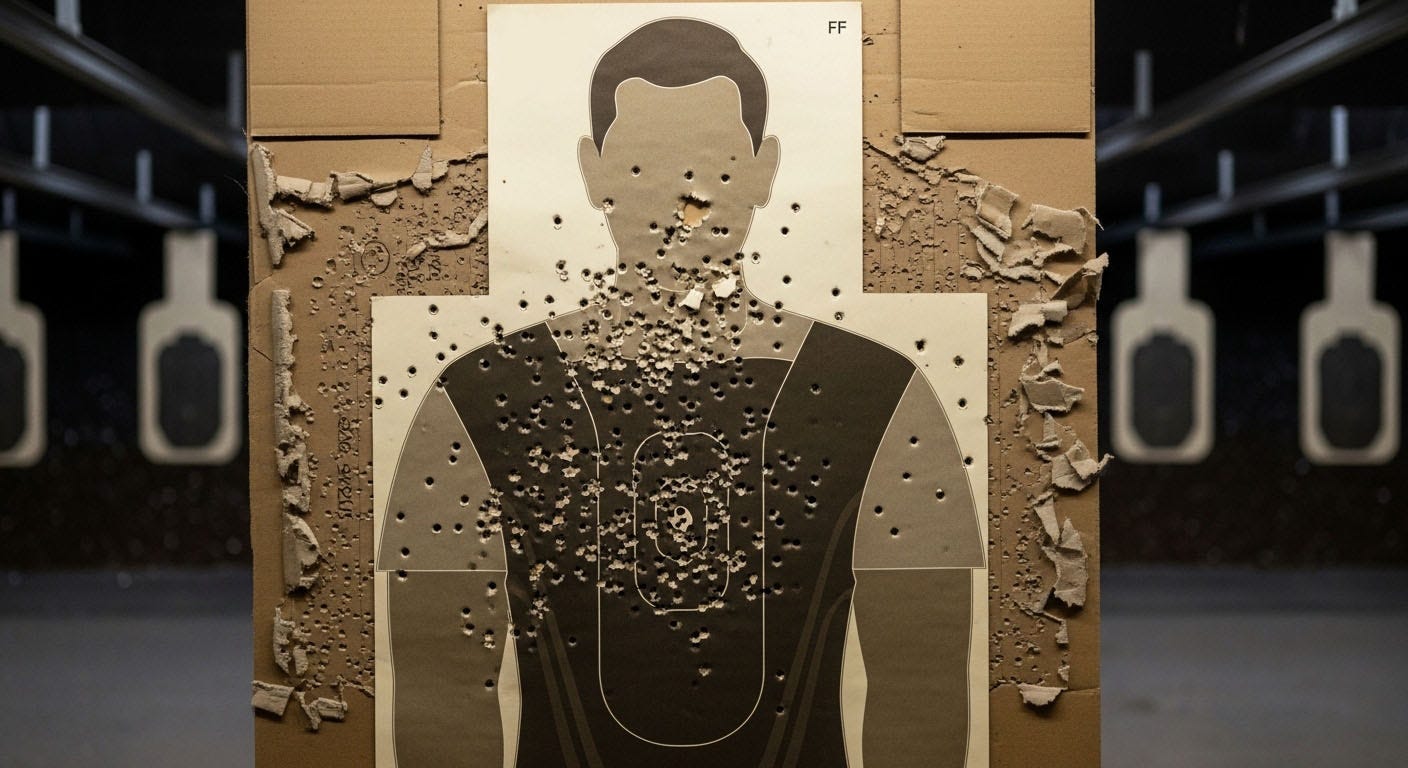
That’s what those older disciplines understood—they didn’t have the luxury of hiding behind speed. If you were off, you saw it immediately, in black and white, right there on the target. There was nowhere to go but back to the basics, and the basics are stubborn things. They haven’t changed nearly as much as we like to think.
Grip still matters. Trigger control still matters. Sight alignment still matters. You can bolt on all the modern gear you want, adopt every flashy new technique that comes down the pipeline, but if those pieces aren’t there, the rest of it is built on sand.
The uncomfortable part is fundamentals are not something you master once and move on from. They’re something you return to, over and over again, usually right after you’ve convinced yourself you no longer need to. This is where the “1955” idea starts to make sense.
It’s not about going backward. It’s about removing the noise and stripping things down to a point where you can’t lie to yourself anymore. No movement, no speed, no distractions—just the shot.
When you do it this way, a few things tend to happen. First, your ego takes a hit. Second, your shooting gets better. Not immediately, and not in a way that feels exciting but in a way that actually holds up when you add the complexity back in.
There’s also a strange kind of satisfaction in it. The kind that doesn’t come from performance, but from understanding. You start to feel what a good trigger press actually is. You recognize what a stable sight picture looks like before the shot breaks. You begin to trust the process instead of trying to outrun your mistakes.
None of this is new and therein lies the point of our podcast episode.
We have a tendency to assume newer automatically means better, and sometimes it does. But, sometimes it just means we’ve found a more complicated way to avoid doing the hard part. The hard part, as it turns out, hasn’t changed much since 1955.
We talked about that this week—what gets lost when we chase speed without control, and what we gain when we slow down long enough to fix it. It’s not a rejection of modern shooting but a reminder that the foundation underneath it still matters.
And maybe that’s what being a “Fudd” really comes down to.
Not living in the past—instead, just remembering what actually works.
Roy! Typing paper!
I don't think they make that anymore...
Computer paper or printer paper!
I'm laughing 😃 with you brother...