


I was scrolling through Facebook the other day, something I rarely do unless I’m procrastinating. As usual, the algorithm served up a steady diet of advertisements for things I didn’t know existed and certainly don’t need.
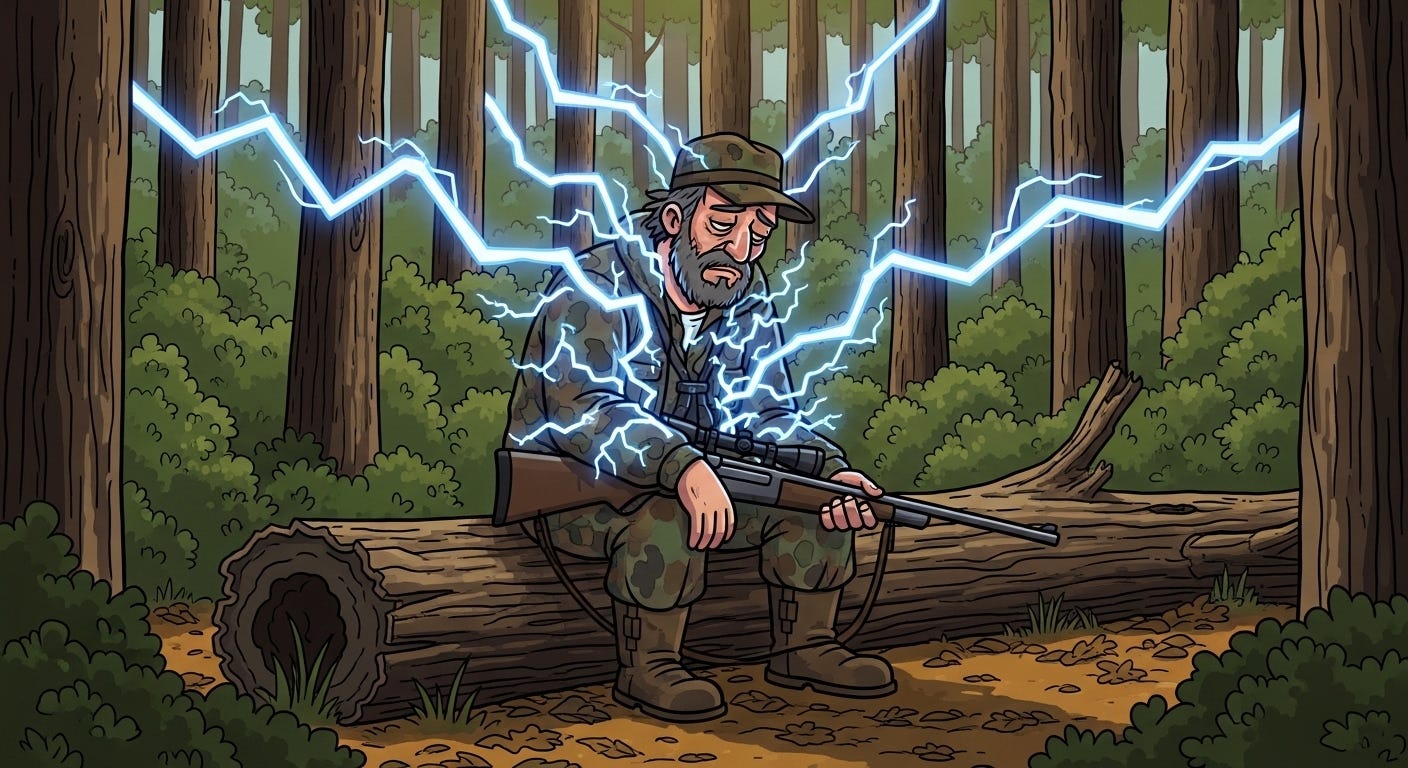
Suddenly, one stopped me cold: it was for “electromagnetic blocking hunting clothes.”
Naturally, I clicked.
Dubious Concept
I’m not going to name the company because—spoiler alert—I think the whole concept is pure snake oil and I’d rather not spend the rest of my life answering emails from lawyers. But if the ad showed up in my feed, there’s a decent chance you’ve seen it too.
The premise goes something like this: the human body emits tiny electromagnetic signals. According to the ad copy, big game animals are sensitive to those emissions. Therefore, if you wear their proprietary garments—made with some sort of mysterious techno-fibers that supposedly block your electromagnetic “signature”—animals won’t detect you.
The implication is that deer, elk, and whatever else you’re chasing will stroll right up and practically feed out of your hand, or something like that.
Now let’s slow down for a moment and consider a few inconvenient facts.
First, yes—the human body does emit extremely small electrical signals. But they’re incredibly minute. In most cases they can only be measured with laboratory equipment that’s physically attached to your body.
We’re talking about signals so weak they require medical instruments.
Second, there are animals that can detect electrical fields. Sharks, for example, famously use specialized organs called the ampullae of Lorenzini to sense the tiny electrical impulses produced by prey animals.
But sharks live in saltwater, which is a fantastic conductor of electricity.
Whitetail deer do not.
Missing Evidence
I’ve searched around and found no credible scientific literature suggesting that mammals—particularly terrestrial ones—are detecting human bioelectric emissions while walking around in the woods.
Which brings us to the practical test: real life.
Because if deer could sense your electrical aura from across the woods, I can think of at least one morning where they should have vacated to the next county over.
Years ago I was sitting at the base of a tree in the dark waiting for turkeys to wake up. It was one of those quiet, still spring mornings where the woods haven’t quite decided whether they’re ready to start the day.
I wasn’t scent-controlled. Not even a little because turkey hunters generally aren’t nearly as obsessive about scent as deer hunters, and I had likely been drinking coffee, sweating on the hike in, and generally smelling like a human being.
Then I heard footsteps. Two does walked in and started feeding. They kept getting closer.
And closer.
Eventually they were within five feet of me.
Five feet.
I could hear them breathing.
At that point I’ll admit I became a little nervous—not because I thought they’d detect my electromagnetic signature, but because two sets of sharp deer hooves could absolutely rearrange my otherwise flawless profile if they spooked.
Fortunately, they fed around me for a bit and eventually wandered off. No panic. No alarm snorts. No reaction whatsoever.
If deer can detect human electrical emissions, those two clearly skipped that day in deer school.
Stand Still, Laddie
In forty years of big-game hunting, I’ve learned a few things about why animals spook. Number one, by a wide margin, is movement.
Humans are terrible at staying still. Modern humans might be even worse. Between fidgeting, checking phones, shifting positions, and generally being uncomfortable, we move far more than we realize.
Animals notice that.
The second big factor is scent. If the wind betrays you, the game is over long before you ever see the animal.
But if you remain completely stock-still and the wind is in your favor, an amazing thing happens.
Animals just do their thing.
They walk past you.
They feed nearby.
Sometimes they get uncomfortably close.
None of that requires special electromagnetic underwear, which brings me back to the Facebook ad.
Hunting companies have been inventing clever ways to separate hunters from their money for a long time. Some innovations are legitimate. Some are incremental improvements. Some are mostly marketing. And, occasionally, something comes along that makes you pause and think, “You’ve got to be kidding me.” Electromagnetic-blocking hunting clothes fall squarely into that last category.
If you want to improve your odds in the woods, here’s a radical suggestion:
Sit still.
Watch the wind.
Pay attention.
Those three things will do far more for your hunting success than any space-age fabric ever will—and they’re still free.